

Copper Roofing in Austin, TX
Get Your Free Estimate
Contact Us

What Homeowners Need to Know
HD Roofing and Repairs Installs Copper Systems Built for Austin's Flat-Pitch Mid-Century Problem
Brentwood and Crestview Carry the Highest Concentration of Low-Slope Rooflines in All of Central Texas
HD Roofing and Repairs is a licensed roofing contractor serving Austin, TX and Travis County. We specialize in copper standing seam installation and copper accent work across Austin residential properties, with a particular focus on the flat and low-pitch rooflines concentrated in Brentwood and Crestview along North Loop Boulevard and Allandale Drive , the drainage geometry that defeats standard shingles and where copper standing seam earns every dollar of its premium. GAF certified and fully insured. City of Austin permits handled. Call (512) 458-6800.
Copper Roofing Credentials That Matter on Austin, TX Properties
What Austin Homeowners Should Ask Before the First Site Visit
- Licensed and insured - active Texas roofing contractor
- Serving Austin, TX and all of Travis County
- Copper standing seam, valley pans, pitch transition flashing, and accent work
- Free copper roofing assessment - call (512) 458-6800
- GAF certified - copper, metal, and shingle systems
Five Years of Austin Heat Has Already Done More Damage Than Your South Slope Shows

Granule Adhesion Fails on the South Slope First; the North Slope Is Closer Behind Than It Looks
Most Austin homeowners who contact us about copper roofing have been watching the south-facing slope shed granules and telling themselves it can wait. Once the granule adhesive bond fails on a south-facing Austin slope exposed to 140-to-165-degree July surface temperatures, the asphalt mat beneath absorbs direct UV and degrades at a rate that moves the replacement window from years to months. South-facing Austin slopes reach functional failure 4 to 7 years ahead of the north-facing slope.

Two Stains From Two Separate Roof Elements in the Same Rain Season Signal System-Wide Failure
One ceiling stain from one isolated failure point is a repair conversation. Two stains appearing below different roof elements on the same Austin property in the same rain season indicate the system has degraded enough that moisture is finding multiple concurrent entry points, and each repair only addresses one symptom while the surrounding shingles continue their decline.

Repeated Caulking at the Same Cherrywood Wall Transition Confirms the Material Is Wrong
Step flashing recaulked twice at the same Cherrywood Road wall transition has reached a diagnostic conclusion. Caulk fails under Austin's January freeze-thaw cycling and re-opens when May thermal expansion arrives. Copper step flashing at that transition eliminates the movement-dependent failure mechanism permanently.
The Austin, TX Roofing Problem Every Mid-Century Neighborhood in Brentwood Has in Common

A 1:12 to 3:12 Pitch Roofline Defeats Shingle Drainage Physics. Copper Standing Seam Does Not Have This Problem
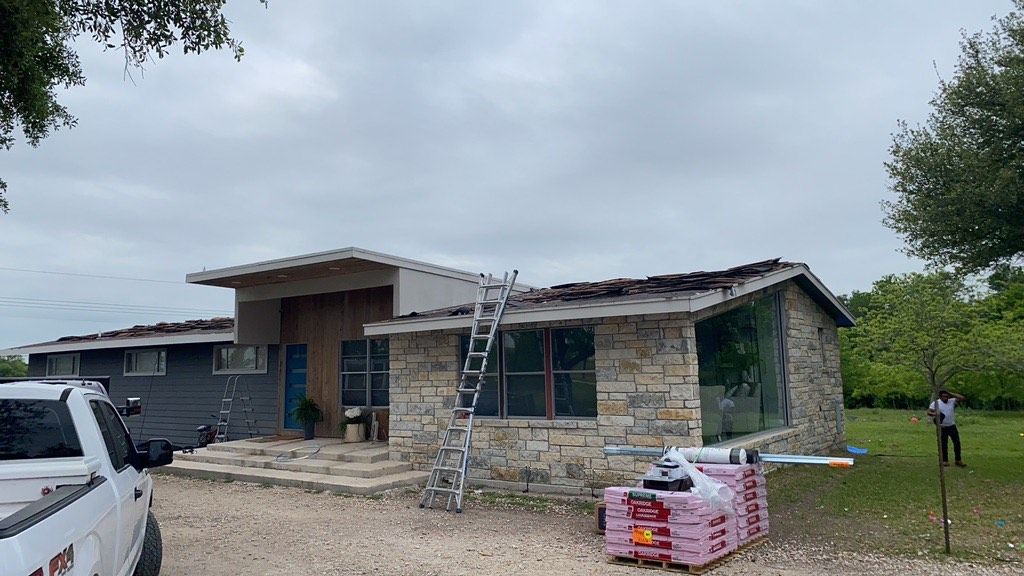
Austin's mid-century construction concentrated in Brentwood and Crestview between 1945 and 1972 produced the highest density of flat and low-pitch primary rooflines in Central Texas, running along North Loop Boulevard and Allandale Drive. At 1:12 to 3:12 pitch angles, shingles lose their gravity-assisted drainage advantage. Copper standing seam's seam profile manages water correctly at these pitch angles regardless of how long moisture sits on the surface. No other city in this project has this concentration of low-slope primary rooflines.

South Congress Avenue's Spring Hail Track Returns to the Same Austin Addresses Every Year
South Austin properties along South Congress Avenue sit in a hail exposure corridor that spring storm tracks cross from March through May. Standard shingle systems absorb impact bruising that in severe years triggers full insurance replacement claims. Copper standing seam in the same storm takes surface denting without the seam lock or drainage geometry being compromised.

Thermal Expansion at Barton Springs Road Pitch Transitions That No Sealant Can Hold Permanently
Custom residential construction along Barton Springs Road carries rooflines with pitch transitions over sunroom and outdoor kitchen additions. Standard galvanized transition flashing at these joints eventually separates at the sealant bond as the adhesive fatigues through Austin's 130-degree annual temperature range. Copper transition flashing moves with the same thermal cycling without depending on sealant.
The Austin, TX Copper Roofing Assessment Process That Drives Every HD Roofing Proposal
Pitch Mapping at Every Slope Determines the Panel Profile Decision Before a Number Is Written
The first step in any Austin copper project is a slope-by-slope pitch assessment that maps every roof section, records every penetration, confirms deck substrate condition, and verifies attic ventilation. Brentwood and Crestview ranches with flat primary sections and addition rooflines at different pitches require this approach because the panel profile for a 1.5:12 addition section differs from the 8:12 primary slope above it.
16-Ounce Cold-Rolled at the Field, 20-Ounce at Every High-Stress Location: Named in Writing Before Authorization
HD Roofing's written proposal for every Austin copper project names the copper alloy and gauge at each application independently. 16-ounce cold-rolled for primary fields and 20-ounce at ridges, valley pans, and chimney cap flashing. No material is ordered until the homeowner's written authorization is received. Copper vs. standing seam comparison: https://www.hdroofingandrepairs.com/is-a-standing-seam-metal-roof-the-right-investment-for-your-pflugerville-home
Installation Moves From Steepest Section Down to Protect the Low-Pitch Deck at Each Stage
HD Roofing sequences installation on Austin's multi-pitch rooflines from the highest pitch section downward, completing the copper field and transition flashing at each level before moving to the section below. This sequencing ensures no open transition joint is left exposed at a higher level while lower sections are being worked.
Three Austin, TX Property Profiles That Each Point to a Different Copper Roofing Decision
The Brentwood Ranch at Its Second Replacement Cycle: Full Standing Seam or Another Shingle
A Brentwood homeowner with a 1.5:12 to 3:12 primary slope at the 20-to-25-year mark faces one binary decision: pay the shingle replacement cost again on a geometry that punishes shingles, or pay the copper premium once and end the cycle. The cost premium over standard Galvalume on a typical Brentwood roofline runs $15,000 to $28,000 depending on square footage.
The Barton Springs Road Estate: When Copper Earns Its Place in the Architecture, Not Just the Spec
Custom construction along Barton Springs Road carries exterior material packages in limestone, stucco, and cedar where copper's warm-to-verdigris patina integrates with the material palette in a way Galvalume never achieves. Full copper standing seam on the primary slopes with copper valley detailing and dormer panels serves both performance and architectural intent.
The Cherrywood Bungalow: Targeted Copper at Key Locations Buys Decades Without a Full System
A Cherrywood Road bungalow undergoing exterior renovation does not need full copper to benefit from copper's permanence. Copper valley lining, copper dormer panels, and copper step flashing at wall transitions remove the highest-maintenance locations from the future repair schedule without replacing the entire primary field. Hidden damage guide: https://www.hdroofingandrepairs.com/how-to-spot-hidden-roof-damage-before-it-leaks-a-cedar-park-homeowners-guide
What June Through September Does to an Austin, TX Rooftop That Faces South or West
Surface Temperatures Hit 140 to 165 Degrees and the South Slope Arrives at Failure 4 to 7 Years Ahead
South and west-facing slopes on Austin properties reach rooftop surface temperatures of 140 to 165 degrees from June through September. A 30-year shingle system rated under national average conditions loses 5 to 10 years of effective service life in Austin's thermal environment. South-facing slopes arrive at granule depletion 4 to 7 years ahead of north-facing slopes on the same roofline.
The March-Through-May Hail Window Tests Whatever Impact Resistance Last Summer Left Behind
The National Weather Service documents multiple hail-producing events across Austin annually, concentrated in the March through May convective season. Each spring hail event tests the granule coverage that survived the previous summer's thermal degradation. Copper exits this cycle entirely: the same event that triggers a full replacement claim on shingles produces cosmetic denting on copper without functional damage. Hail damage guide:
https://www.hdroofingandrepairs.com/hail-and-wind-damage-restoration-in-georgetown-a-spring-homeowner-guide
Austin, TX Roofline Geometry by Neighborhood: Each Address Is a Different Copper Problem
North Loop Boulevard and Allandale Drive: Flat-Pitch Mid-Century Ranches That Punish Shingles
Brentwood and Crestview, built primarily between 1948 and 1968 along North Loop Boulevard and Allandale Drive, carry the highest concentration of flat and low-pitch primary rooflines in Austin. Copper standing seam manages water correctly at 1:12 to 3:12 pitch angles where shingle lap drainage geometry fails, and these neighborhoods are where the material makes its strongest practical argument.
Cherrywood Road and Patterson Avenue: Craftsman Bungalows Where Copper Is Historically Correct
The residential inventory along Cherrywood Road and Patterson Avenue in Hyde Park includes Craftsman bungalows built between 1910 and 1940 with steep-pitch gabled rooflines and dormer work where copper is historically appropriate. Renovations in these Austin neighborhoods increasingly specify copper dormer panels, valley lining, and step flashing as architecturally correct choices.
Barton Springs Road Custom Builds: Multi-Valley Complexity That Requires Multi-Point Copper Specification
Custom residential construction along Barton Springs Road carries rooflines with multiple valley intersections, significant penetration density from HVAC equipment, and covered outdoor living structures requiring material decisions at each element. Copper standing seam integrates these complex elements into a single permanent maintenance profile.
How HD Roofing Moves an Austin, TX Copper Project From First Call to Transferable Warranty
The Pre-Proposal Deck and Ventilation Audit Happens Before Any Scope Is Discussed
Before any Austin copper scope is written, HD Roofing audits deck substrate condition at every pitch section, slope geometry and panel profile requirements at each level, and attic ventilation net free area. Nothing is estimated. Scope changes discovered during installation stop work at the discovery point and require written homeowner authorization before proceeding.
City of Austin Development Services Department Permit Filed Before Installation Begins
Roof replacement within Austin city limits requires a permit from the City of Austin Development Services Department at 6310 Wilhelmina Delco Drive, Austin, TX 78752, (512) 978-4000. HD Roofing confirms the permit requirement, files before installation begins, and delivers the permit record to the homeowner at project completion.
Documentation Delivered at Project Close Transfers to the Next Austin Buyer With the Warranty
HD Roofing's workmanship warranty on every Austin copper installation transfers to a subsequent buyer at property sale, along with the post-installation documentation record. In Austin's active real estate market, a transferable workmanship warranty combined with a full installation specification is a concrete asset in any resale transaction.
Have Travis County Copper Questions? Get a Straight Answer From Our Team Today
North Loop Boulevard, Brentwood: A Three-Failure Roofline Two Prior Contractors Misread
The Third Repair Attempt on a 1.5:12 Addition Revealed a Problem That Started at the Deck
Last summer, a homeowner on North Loop Boulevard in Brentwood contacted HD Roofing after the third repair attempt on a 1.5:12 pitch bedroom addition had failed to stop active water entry at the rear valley. The addition had been recaulked twice, and a lap-patch flashing had been applied over the original valley pan. The primary 3:12 roof was 18 years old and in sound condition.
The turning point: deck probe at the valley base confirmed through-deterioration in the OSB core from repeated wet-dry cycling. Another season through the same entry point would have significantly expanded the deck scope. Written proposal: full tear-off of the addition field, OSB replacement at the valley base, 16-ounce copper standing seam with a low-pitch panel profile, copper valley pan from ridge to eave, primary slope shingle reinstallation. Itemized cost: addition copper field $6,200. Copper valley pan $1,100. Deck board replacement $480. Shingle reinstallation $890. City of Austin permit $225. Total: $8,895.
Copper Roofing Prices in Austin, TX: What Drives the Number Up and What Keeps It in Range
Full Standing Seam on Austin Residential Properties: $18 to $32 Per Square Foot Installed
Full copper standing seam installation in Austin runs $18 to $32 per square foot installed, with the final number determined by total square footage, the number of pitch sections and transitions, deck condition at tear-off, panel profile complexity at low-pitch sections, and the gauge specification at high-stress locations. A 1,600-square-foot Brentwood ranch with a straightforward roofline and sound deck runs $28,800 to $40,000 installed. A complex property along Barton Springs Road with multiple valleys, dormers, and penetration density runs toward the upper range or above.
Copper at Valley and Dormer Locations Only: What Targeted Austin Applications Cost
Copper valley lining added during a standard re-roofing project runs $350 to $1,100 per valley depending on run length and deck condition. Copper dormer roofing on a Cherrywood bungalow runs $900 to $2,400 per dormer. Copper counter-flashing replacement at a chimney stack on a Hyde Park renovation runs $550 to $1,300 depending on chimney face count.
The City of Austin Permit Fee Appears as Its Own Line in Every HD Roofing Proposal
City of Austin Development Services Department permit fees for residential roof replacement run $150 to $350 depending on project valuation and appear as a separate line item in every HD Roofing Austin proposal. Properties outside Austin city limits but within unincorporated Travis County file with a different authority. HD Roofing identifies the correct jurisdiction for each property before writing any proposal.
One Hundred Years of Performance Against a Climate That Cuts Every Competitor's Lifespan Short
UV Does Not Degrade Copper: Why Austin's 165-Degree July Surface Temperatures Are Irrelevant to It
Copper standing seam on an Austin property carries a 100-plus-year service horizon regardless of slope orientation. The thermal loading that removes 5 to 10 years from a standard shingle system's rated life in Austin's heat does not affect copper because copper's degradation mechanism is atmospheric oxidation, not UV-driven asphalt binder breakdown.
Verdigris on South-Facing Austin Slopes Appears Between Years Eight and Fifteen; Not Year One
New copper on an Austin property transitions from bright warm-tone to amber and brown within two to four years as surface oxidation progresses. Early verdigris appears at seams and valley transitions by years eight to fifteen on south-facing slopes. Full blue-green patina develops over twenty to thirty years, driven by atmospheric oxidation, not UV loading.
The Installation Details That Separate a 100-Year Austin Copper System From a 25-Year One

High-Temperature Self-Adhering Underlayment Under South Slopes Where Standard Products Reach Their Limit
Standard synthetic underlayment rated to 220 to 250 degrees Fahrenheit sits at the boundary of its thermal tolerance beneath copper standing seam on Austin's south-facing slopes in July. HD Roofing specifies high-temperature self-adhering underlayment beneath all Austin copper fields, providing the thermal margin a 100-year system requires at the deck-underlayment interface and eliminating the lap vulnerability that standard underlayment develops under sustained high temperatures from the panel above.
Clip Spacing Calculated to Austin's Specific January-to-July Thermal Range, Not a National Average
Concealed copper clip spacing on an Austin installation is calculated from the panel manufacturer's thermal movement data across Austin's temperature profile, from January lows near 30 degrees to July surface temperatures above 140 degrees. Clips spaced to a generic standard that underestimates Austin's thermal cycling amplitude gradually transfer stress to the seam lock. Call (512) 458-6800 to have attic ventilation confirmed before installing a permanent copper system.
Net Free Ventilation Area Confirmed at Each Attic Zone Before the First Panel Is Ordered
Insufficient attic ventilation allows heat buildup that drives moisture cycling in the deck sheathing even through Austin's low-humidity summers. HD Roofing verifies net free ventilation area against attic floor area before every Austin copper installation and documents any deficiency as a scope item in the written proposal.
Galvalume vs. Copper on an Austin, TX Roofline: The Math Over 100 Years
One Austin Copper Installation vs. Two Galvalume Cycles: The Long-Term Ownership Calculation
Standard Galvalume on an Austin property carries a 40-year service life; copper carries 100-plus years. On a 2,000-square-foot Austin roofline, the installed cost differential runs $20,000 to $35,000 depending on complexity.
The Five Line Items a Below-Market Austin Copper Quote Is Most Likely Skipping
A copper roofing quote for an Austin property that falls significantly below HD Roofing's installed range typically omits five items: 16-ounce cold-rolled copper replaced with lighter copper-coated steel, exposed fasteners instead of concealed clip systems, standard underlayment instead of high-temperature underlayment, no City of Austin Development Services permit filing, and no post-installation documentation record. Each omission shortens the system's service life and removes the permanence that justifies the copper investment.
What Austin, TX Homeowners Receive From HD Roofing That Other Copper Contractors Don't Provide
A Proposal That Names the Alloy and Gauge at Every Application Before Any Panel Is Ordered
Before HD Roofing orders a single panel on any Austin copper project, the homeowner receives a written proposal naming the alloy, gauge, fastening system, underlayment, and complete installed cost. No scope item appears mid-project as an unexpected add-on. Austin homeowners who have received vague copper proposals elsewhere should ask for the alloy specification in writing before signing anything , the alloy specification is what determines whether the system performs for 100 years or for 25.
A Workmanship Warranty That Follows the Property Through Resale, Not Just the Original Owner
HD Roofing's workmanship warranty on every Austin copper installation transfers to a subsequent buyer at property sale, along with the post-installation documentation record. In Austin's active real estate market, a transferable workmanship warranty combined with a full installation specification is a concrete asset in any resale transaction , the next buyer receives both warranty coverage and the complete installation reference without requiring a new assessment.
Austin-Specific Project Experience Across Mid-Century, Craftsman, and Estate Property Types
HD Roofing has installed copper standing seam and copper accent work on mid-century ranches in Brentwood, Craftsman renovations in Cherrywood, and estate properties along Barton Springs Road. That Austin-specific project experience is the foundation of every written proposal HD Roofing produces.
Austin, TX Copper Roofing: Questions Answered Straight
What makes a 1:12 or 2:12 pitch roofline in Brentwood or Crestview such a good candidate for copper?
Low-pitch applications down to 1:12 are within copper standing seam's correct installation range when the panel profile matches the slope. Brentwood and Crestview mid-century rooflines at 1.5:12 and 2:12 are exactly where copper outperforms every alternative because the seam profile manages water at angles where shingle lap drainage geometry stops working.
Does the City of Austin require a permit to install copper roofing?
Residential roof replacement within Austin city limits requires a permit from the City of Austin Development Services Department at 6310 Wilhelmina Delco Drive, Austin, TX 78752, (512) 978-4000. HD Roofing confirms the requirement and files before installation begins.
How long before an Austin copper roof develops the green patina?
South-facing Austin slopes with regular spring precipitation typically show early verdigris at seams and valley transitions between years eight and fifteen. Full blue-green patina across the entire field develops over twenty to thirty years, driven by atmospheric oxidation chemistry rather than UV loading , Austin's intense summer sun does not accelerate the timeline.
What is the real difference between copper-coated steel and solid cold-rolled copper?
Copper-coated steel is a galvanized base sheet with a thin copper layer bonded to its surface, carrying a 25 to 35-year service life rather than 100-plus years. Solid cold-rolled copper is copper throughout its full thickness and delivers the hail resistance profile, the patina chemistry, and the service horizon that justify the copper investment. HD Roofing installs solid 16-ounce cold-rolled copper and names that specification in every written proposal.
What underlayment does HD Roofing specify beneath copper fields on Austin properties?
High-temperature self-adhering underlayment is standard on every HD Roofing Austin copper installation. Standard synthetic underlayment sits at the boundary of its thermal tolerance beneath copper panels on Austin's south-facing slopes in July.
Can HD Roofing add copper at valley and dormer locations only, without replacing the full Austin roof?
Copper valley lining, dormer panel installation, step and counter flashing at wall transitions, and chimney cap flashing replacement are all standalone scope items HD Roofing installs independently of any main roof system decision.
How does Austin's spring hail season affect a copper roof differently than shingles?
Hail impact on copper standing seam produces surface denting at the impact point without compromising the seam lock or drainage geometry below. The same event on a 15-year-old shingle system displaces granules and in severe events triggers insurance replacement claims. Austin copper properties do not generate hail replacement claims after events that total shingle roofs in the same neighborhood.
How do Austin appraisers and buyers view a copper roof during resale?
Austin appraisers familiar with premium roofing materials recognize copper as a permanent improvement that removes roof replacement from the property's future cost profile. A correctly documented copper installation with a transferable warranty eliminates roof replacement from the inspection contingency, consistently strengthening the seller's negotiating position in Austin's mid-century and estate market segments.
How does HD Roofing handle unexpected deck damage found during an Austin tear-off?
Work stops at the location of the deck discovery. HD Roofing photographs the affected area, documents the extent, and contacts the Austin homeowner with a written scope amendment before any additional work proceeds.
How should an Austin homeowner compare competing copper roofing proposals?
Four items require written confirmation in every Austin copper proposal: the alloy and gauge at every application named independently, the panel profile specified per pitch angle, the City of Austin permit filing plan, and the post-installation documentation commitment.
Other Roofing Work HD Roofing Handles for Austin, TX Residential Properties
Austin, TX Copper Roofing Assessment: Free, Written, and Ready to Schedule Now
Austin homeowners who install copper in 2025 make the last roofing decision this property will ever require. HD Roofing and Repairs serves all of Austin, TX and Travis County, from the flat-pitch mid-century ranches along North Loop Boulevard to estate properties along Barton Springs Road. Every project begins with a written proposal naming the alloy, gauge, panel profile, and complete installed cost. Call (512) 458-6800 for your free Austin copper roofing assessment.
Schedule Your Travis County Copper Roofing Estimate Today